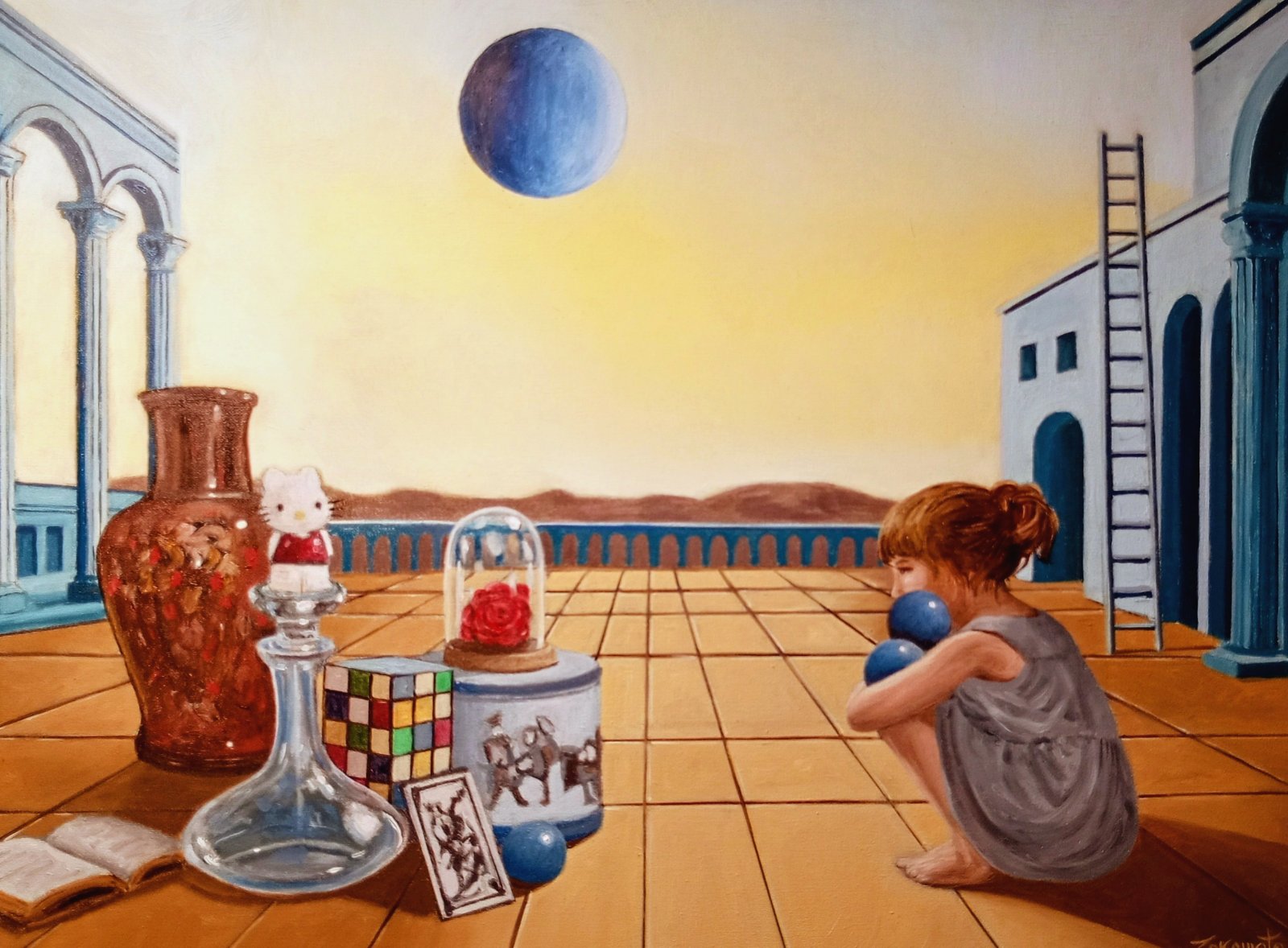
Since I was 8 I have been collecting my dreams in notebooks kept beside the bed. The first dream is dated 6 June 1982: «On the horizon a storm coming in, Harlequin passes in front of me astride a thoroughbred». I did not know then that Harlequin, before being a mask, had been a demon: the Hellequin of medieval legend, leader of the wild hunt, ferryman of souls.
The method has stayed the same; it has only refined itself into discipline. In less productive periods I force myself to sleep for a few minutes, with background noises of traffic or vacuum cleaners, and zealous alarm clocks that wake me and let me note down in the current notebook a dream just dreamt. It is a technique as old as modernity: Salvador Dalí called it «slumber with a key» — you fall asleep in an armchair with a heavy key between your fingers, above an upturned plate; at the first yielding of sleep the key falls, the plate rings, and you come back over here with the loot still warm. Thomas Edison did the same with steel balls in his fists. Kekulé saw the benzene ring in a snake biting its own tail, Tartini had the Devil's Trill dictated to him by the devil in person, Stevenson delegated his novels to his nocturnal «brownies», McCartney woke up with Yesterday already finished. Hypnagogia is the free zone where the brain works for nothing: I have merely added the bureaucracy — numbered notebooks, dates, alarm clocks. I am the zealous clerk of my own dreams, the Vogon pigeon-functionary of my unconscious.
There exists a small library of those who have kept the accounts of their own dreams: Georges Perec's La Boutique obscure, 124 dreams catalogued like finds; Fellini's Book of Dreams, which turned his nights into circus-coloured plates; Jung's Red Book, illuminated like a medieval codex; Burroughs's dream diaries. And there is Akira Kurosawa, who at eighty gave up all plot in order to film eight dreams just as they were (Dreams, 1990).
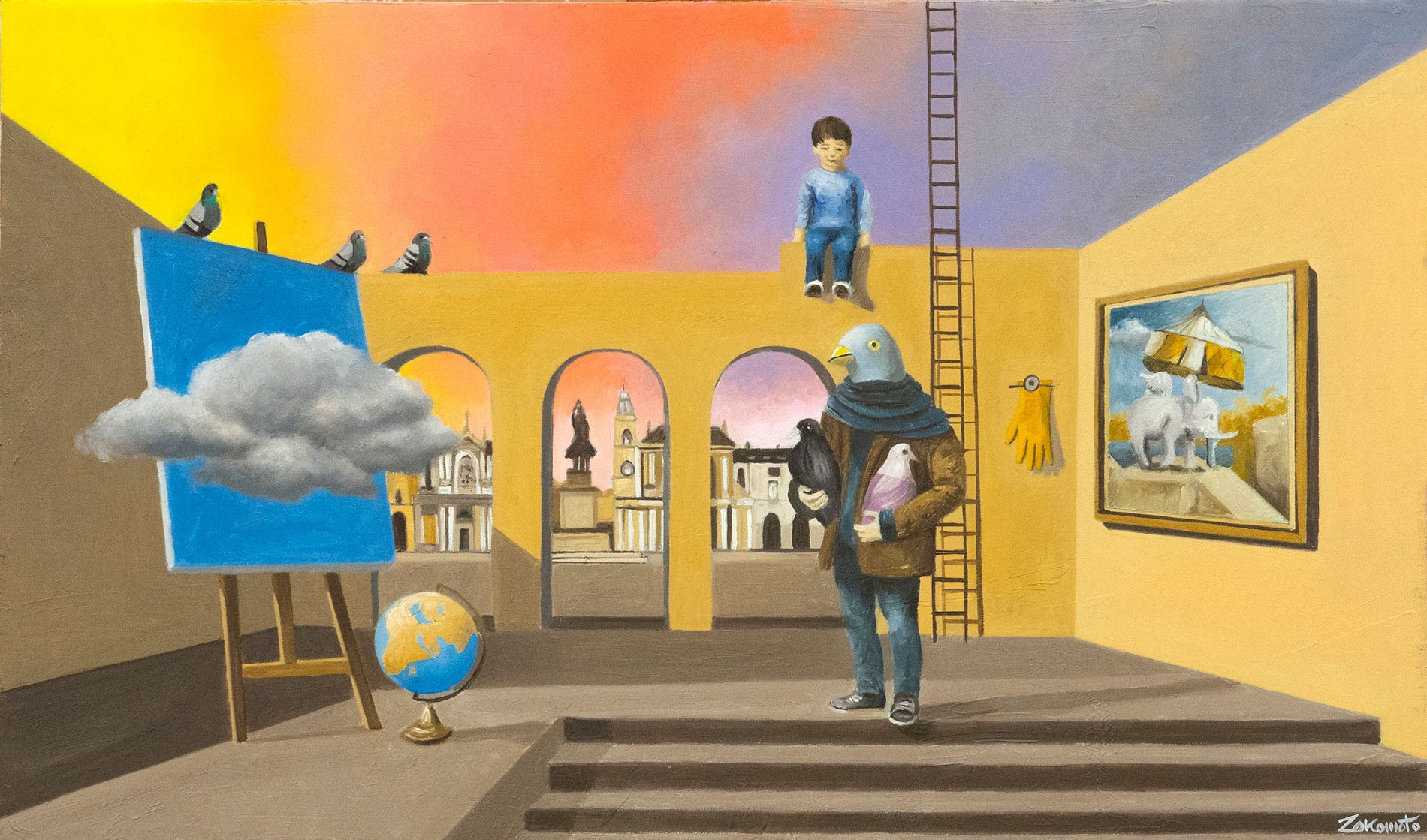
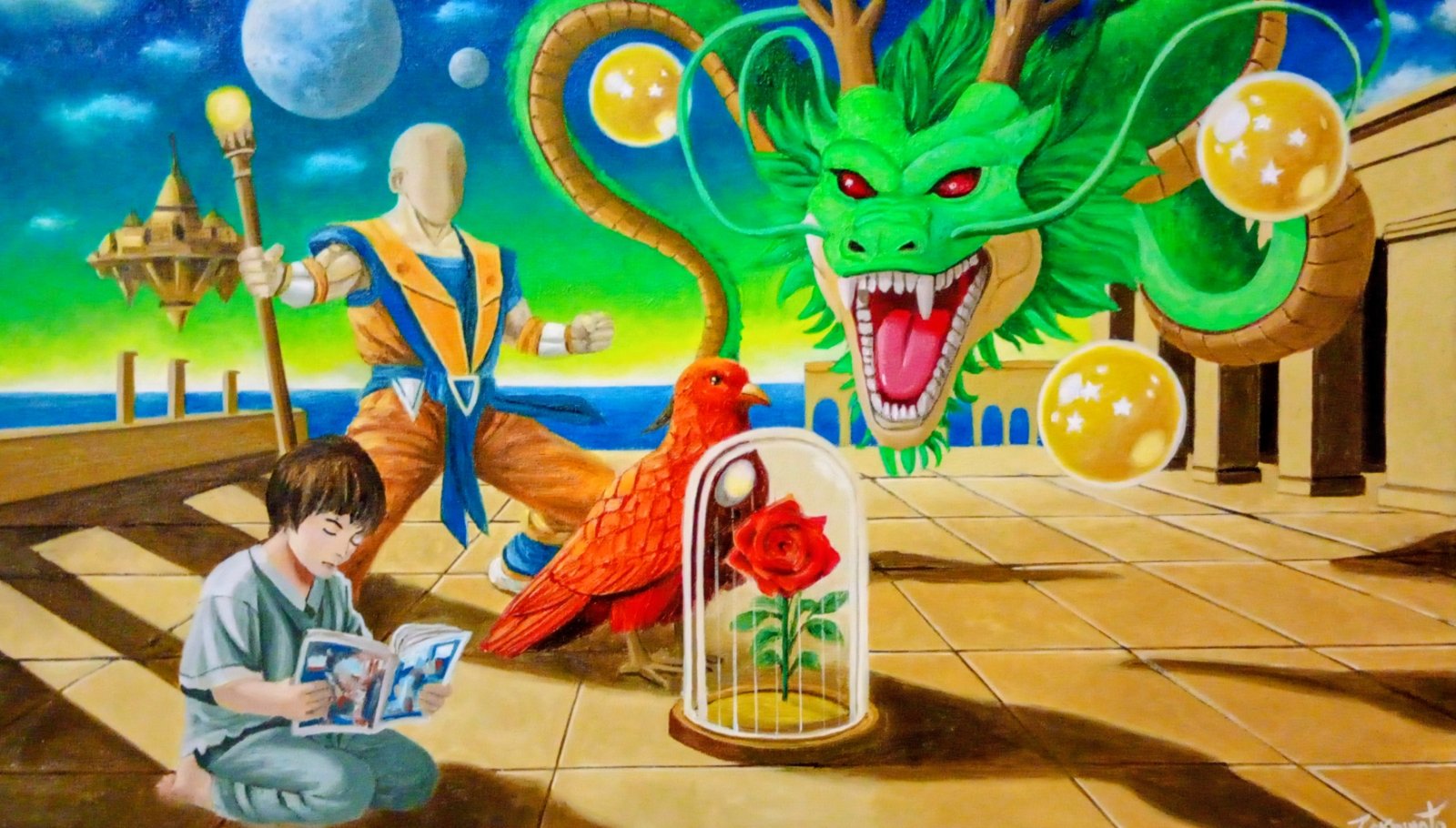
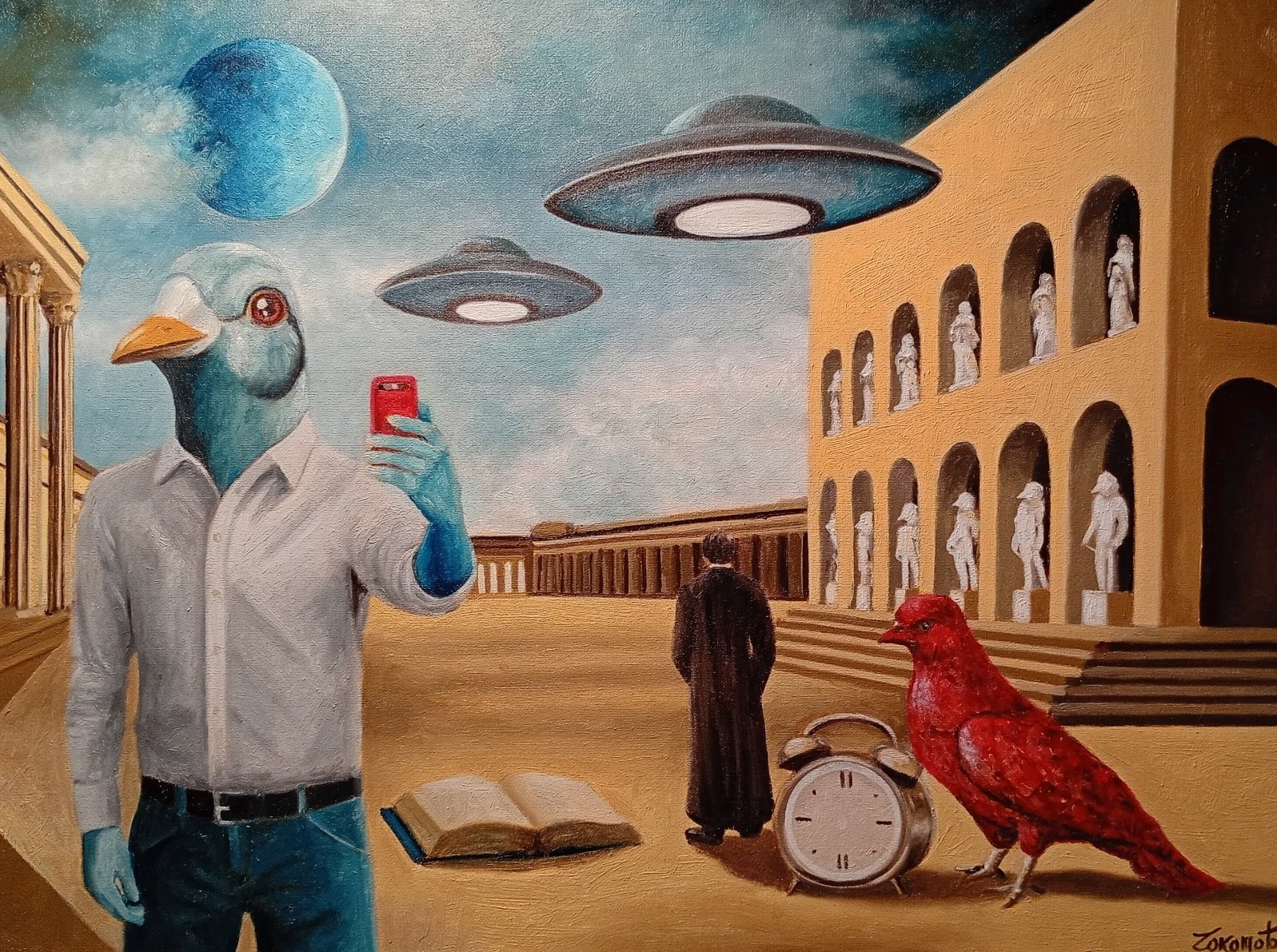
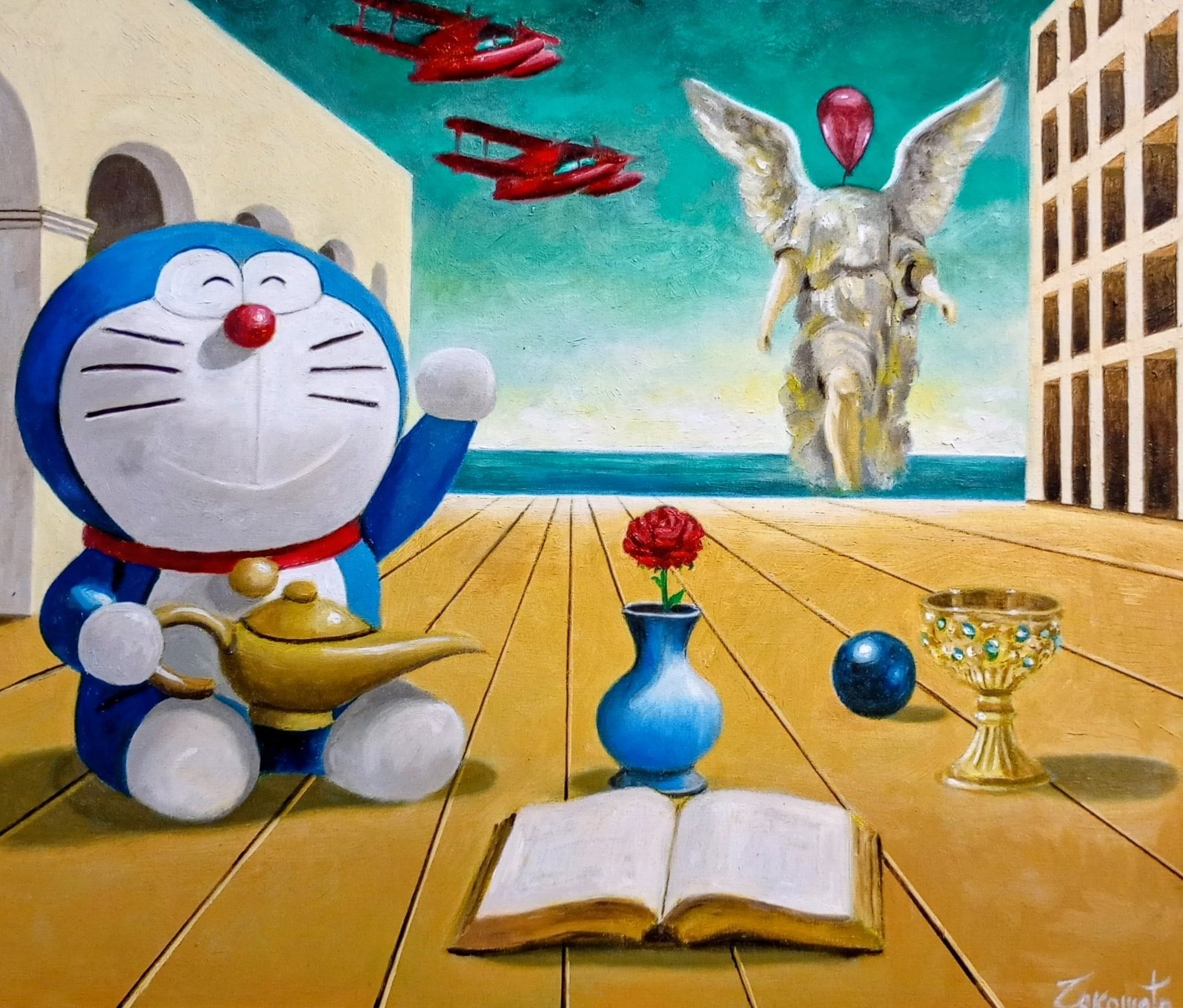
To paint one's own dreams is a mystical experience: it is like painting one's own brain in its idle moments. Neuroscientists call it the default mode network, the network that lights up when we are doing nothing; dreams are the art produced by that network, the only truly involuntary artistic production — without a market, without patrons, without critics, without artificial intelligence, for now. Every night the brain mounts a solo show with free admission, and on waking dismantles it. The Dreams series is the attempt to save a few pictures from the dismantling.
The dreams of this series almost all take place in the same location: a sunlit, deserted square, arcades, long shadows, horizons too close, skies of a wrong colour. It is the stage set that Giorgio de Chirico patented between 1910 and 1918 and that nobody has ever been able to dismiss, because it is not a style: it is the very architecture of dream. Not by chance was Metaphysics born in my own city: Turin, or rather from the idea of Turin — the arcaded squares, the equestrian statues, the geometrical shadows of October. To work on a series about dreams in a Turin studio means painting on location: the raw material is outside the door.
The grammar is the one Freud attributed to the dream-work: condensation and displacement. In dreams figures merge (a man is also a pigeon), objects migrate from their context (an alarm clock in the middle of a square, a glove hanging on a wall), proportions lie, time stops on a clock that always shows the same hour. Metaphysical painting has never done anything else: it is dream montage in oils. And as in dreams, the tenants of these squares do not respect cultural hierarchies. The dreaming brain does not distinguish between high and low, between the angel and Doraemon, between the Grail and the dragon ball: it files everything in the same warehouse and at night fishes at random. For a child who grew up in the eighties, the collective unconscious is broadcast on TV in the afternoon: its archetypes are called Shenron, Doraemon, Hello Kitty. Late-afternoon Jungians.
Dreams is also the place where the other series come to sleep: the pigeon-men of Stop the Pigeon, the headless spheres of Quarantine, the little cat of Kitty die Katze, the rose under its bell jar that is already in Deflorationis, the enormous childhood of The Return of the Giants.
If every series is a heteronym, the dream is the room where the heteronyms meet without introducing themselves. G. Zakamoto writes up the minutes of these meetings first thing in the morning.
Suggested reading
Giorgio de Chirico — The Enigma of the Hour (1911), The Song of Love (1914), the Italian Squares, Hector and Andromache (1917), Mysterious Baths (1973). The square, the glove, the clock, the mannequin, the statue: the whole scenographic lexicon of the series.
René Magritte — La condition humaine (1933), L'empire des lumières (1949–54). The picture within the picture and the cohabitation of day and night.
Salvador Dalí — The Persistence of Memory (1931), Dream Caused by the Flight of a Bee (1944), The Elephants (1948), Meditative Rose (1958); «slumber with a key» in 50 Secrets of Magic Craftsmanship (1948); the dream sequence in Hitchcock's Spellbound (1945) and the short film Destino with Disney (1945–2003).
Max Ernst — The Elephant Celebes (1921).
Paul Delvaux — the sleepwalking women, the night stations, the moonlight on classical architecture.
Henri Rousseau — The Dream (1910).
Johann Heinrich Füssli — The Nightmare (1781); Francisco Goya — The Sleep of Reason Produces Monsters (1797–99). The nocturnal, uncanny branch of the genealogy.
Joan Miró — Dog Barking at the Moon (1926): the ladder towards the sky.
Artemidorus of Daldis — Oneirocritica (2nd century AD): the first bureaucracy of dreams.
Sigmund Freud — The Interpretation of Dreams (1899): condensation, displacement, wish-fulfilment, das Unheimliche (1919).
Carl Gustav Jung — The Red Book: archetypes and the collective unconscious (in the afternoon-television edition).
Hervey de Saint-Denys — Dreams and How to Guide Them (1867): the pioneer of lucid dreaming.
Hypnagogia and creative incubation: Edison and the steel balls, Kekulé and the benzene ring (1865), Tartini and the Devil's Trill, Stevenson and the «brownies» (A Chapter on Dreams), McCartney and Yesterday (1965).
Georges Perec — La Boutique obscure. 124 Dreams (1973).
Federico Fellini — The Book of Dreams (publ. 2007).
William S. Burroughs — My Education: A Book of Dreams (1995).
Akira Kurosawa — Dreams (1990): eight dreams filmed without a plot, the direct precedent of the series.
Satoshi Kon — Paprika (2006); Christopher Nolan — Inception (2010): dream as shared technology.
Hayao Miyazaki — Laputa: Castle in the Sky (1986), Porco Rosso (1992): the flying island and the red seaplanes, the animal-man who flies in the interstices.
Winsor McCay — Little Nemo in Slumberland (1905): the dream as comic strip, with the obligatory fall out of bed in the last panel.